Skip to content
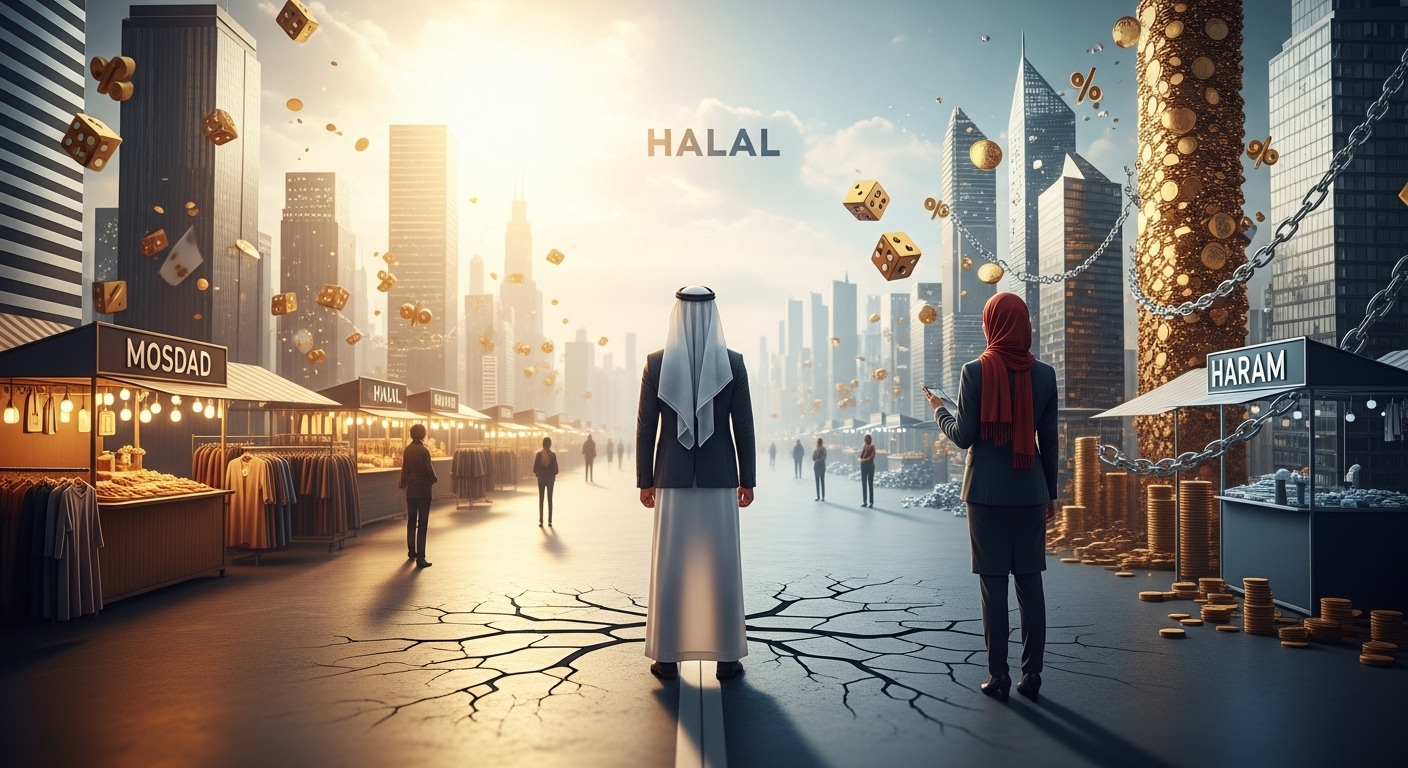
Haram business in Islam is a critical area of understanding for every Muslim entrepreneur and professional. In Islam, the pursuit of sustenance, or rizq, is not merely a worldly endeavor; it is an act of worship. How we earn our livelihood is as important as how we pray or fast.
The money we bring home feeds our families, clothes our children, and sustains our lives. Therefore, ensuring this income is pleasing to Allah is paramount. It is the foundation upon which a life of blessings, or barakah, is built. We often ask ourselves about the specifics of our prayers and our charity, but a fundamental question that deserves equal attention is: Is my income Halal?
This question guides the modern Muslim through a complex global economy filled with opportunities and potential pitfalls. The goal of this guide is to provide a clear and comprehensive framework for understanding the difference between Halal and Haram business in Islam.
We will explore the foundational principles derived from the Quran and Sunnah, analyze contemporary business models, and offer clarity on navigating this essential aspect of our faith. We aim to define what constitutes a Haram business in Islam and provide modern, practical examples to empower you to build a business or career that is not only financially successful but also spiritually fulfilling and blessed by the Almighty.
The Foundation: What Makes a Business Halal or Haram?
To properly identify a Haram business in Islam, we must first understand the core principles that govern commerce in our faith. Islamic jurisprudence on transactions, known as Fiqh al Muamalat, is built upon a beautifully simple and empowering foundation.
It is not designed to restrict enterprise but to channel it in a way that ensures justice, fairness, and ethical conduct for everyone involved. These principles protect society from exploitation, uncertainty, and social decay, fostering an economic environment where prosperity and morality coexist.
The Golden Rule: Everything is Halal Unless Stated Otherwise
The default ruling in Islamic commercial law is permissibility. This is based on the famous legal maxim, “Al Asl fi al Ashya al Ibahah,” which translates to “The default ruling on things is permissibility.” This principle is a manifestation of Allah’s mercy. He has not burdened us with a limited list of permissible activities. Instead, He has given us a vast world of opportunities to explore, innovate, and prosper in.
“What Allah has made lawful in His Book is halal and what He has forbidden is haram, and what He has remained silent about is a concession. So accept the concession from Allah, for Allah is not forgetful” (Sunan al Tirmidhi).
This powerful hadith establishes a core principle of Islamic jurisprudence: unless something is explicitly forbidden by a clear text from the Quran or Sunnah, it is considered permissible. It shows the vastness of Allah’s mercy and empowers Muslims to innovate and engage with the world confidently, knowing their boundaries are clearly defined.
A Muslim entrepreneur can therefore confidently assume that their new business idea is acceptable unless it clearly falls into one of the prohibited categories. This liberates the spirit of enterprise and encourages creativity within a divine ethical framework. The prohibitions act as the clear red lines, the boundaries that protect us from harming ourselves and others.
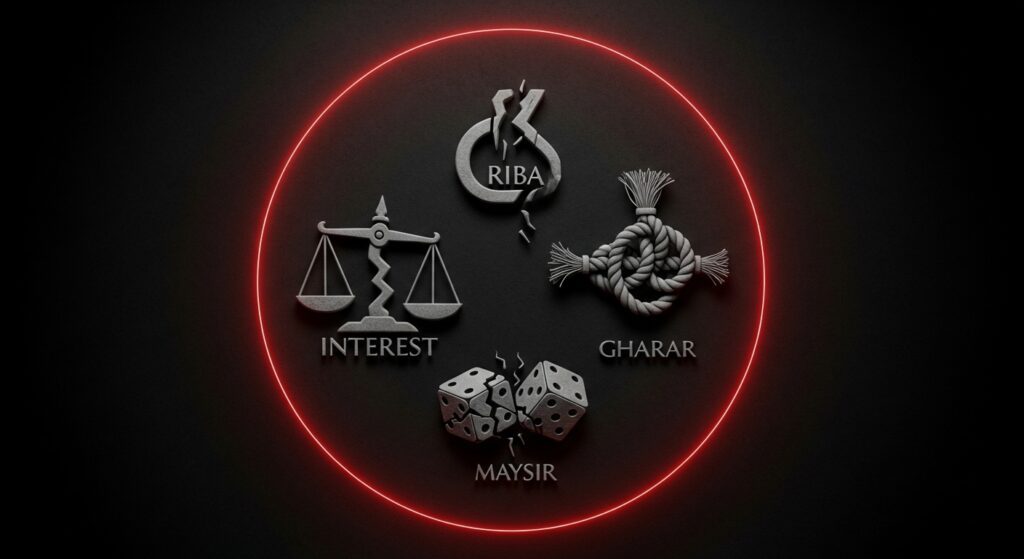
The Red Lines: Key Prohibitions in Islamic Commerce
While the default is permissibility, Islam has set firm boundaries to prevent economic injustice and moral corruption. Understanding these prohibitions is the key to avoiding a Haram business in Islam.
Riba (Interest/Usury)
Perhaps the most significant prohibition in Islamic finance is Riba. Linguistically, Riba means to increase or to exceed. In Islamic terminology, it refers to any predetermined, guaranteed excess in a loan transaction, essentially earning money from money without engaging in a real economic activity.
“Those who consume interest cannot stand [on the Day of Resurrection] except as one stands who is being beaten by Satan into insanity. That is because they say, ‘Trade is [just] like interest.’ But Allah has permitted trade and has forbidden interest… Allah destroys interest and gives increase for charities.” (Quran, Al Baqarah 2:275-276).
This verse draws a clear and non negotiable line between legitimate trade and interest. It highlights the spiritual disease that afflicts those who consume Riba, comparing their state to insanity. It also contrasts the destructive nature of interest, which diminishes true wealth and blessings, with the productive nature of charity, which Allah causes to grow.
“O you who have believed, fear Allah and give up what remains [due to you] of interest, if you should be believers. And if you do not, then be informed of a war [against you] from Allah and His Messenger.” (Quran, Al Baqarah 2:278-279).
These verses represent one of the most severe warnings in the Quran. Engaging in Riba is equated to being in a state of war with Allah and His Messenger (peace be upon him). This emphasizes the gravity of the sin, highlighting its destructive impact not just on the economy but on one’s very faith and relationship with the Creator.
Historically, the early Muslim community in Madinah built a thriving economy based on interest free trade, partnerships (Mudarabah and Musharakah), and charitable loans. Any business model that relies on charging or paying interest, such as conventional banking, interest based loans, or bonds, falls directly into the category of a Haram business in Islam. For a deeper understanding, you can explore the principles of Islamic Finance with the World Bank.
Gharar (Uncertainty/Deception)
Gharar refers to excessive uncertainty, ambiguity, or deception in a contract that could lead to a dispute. Islam requires all terms of a contract to be clear, transparent, and known to all parties to prevent exploitation. This principle is derived directly from the Sunnah.
The Prophet Muhammad (peace be upon him) forbade transactions involving uncertainty, such as “the sale of the pebbles” (where one would throw a pebble and buy whatever it landed on) and “the sale of the unborn animal in its mother’s womb” (Sahih Muslim).
These Ahadith provide tangible examples of Gharar. In both cases, the subject of the sale is ambiguous and unknown, leading to potential conflict and injustice. These prohibitions establish the principle that all contracts must be transparent and the goods or services clearly defined to be valid in Islam.
Modern examples of Gharar could include complex derivative contracts where the underlying asset’s future value is purely speculative, or insurance contracts where the payout and its timing are uncertain. A business built on ambiguity or withholding critical information from its customers is engaging in Gharar.
Maysir (Gambling/Speculation)
Maysir means gambling, which is acquiring wealth by pure chance or luck, rather than through effort and productive work.
“O you who have believed, indeed, intoxicants, gambling, [sacrificing on] stone alters [to other than Allah], and divining arrows are but defilement from the work of Satan, so avoid it that you may be successful.” (Quran, Al Ma’idah 5:90).
In this verse, Allah groups gambling (Maysir) with other major sins like consuming intoxicants and idolatry. He describes them as “defilement from the work of Satan,” indicating their corrupting influence on an individual’s faith and society.
The command to “avoid it” is a command for complete dissociation from such activities to achieve true success (falah). In a gambling transaction, one party’s gain is directly derived from another party’s loss. This fosters enmity, greed, and a desire for unearned wealth, while discouraging hard work and productive enterprise.
Prohibited Goods & Services
Finally, a business is considered Haram if it deals in goods or services that are explicitly forbidden in the Quran and Sunnah.
“He has only forbidden to you dead animals, blood, the flesh of swine, and that which has been dedicated to other than Allah.” (Quran, Al Baqarah 2:173).
This verse from the Quran provides a foundational list of prohibited food items. By extension, any business involved in the production, processing, or sale of these items is inherently Haram. The prohibition is clear, direct, and non negotiable for believers.
“Verily, Allah has forbidden the sale of alcohol, dead meat, pork, and idols.” (Sahih al Bukhari).
This hadith complements the Quranic verse by explicitly forbidding the sale of these items. It clarifies that it is not just the consumption that is Haram, but profiting from them through commerce is also a major sin.
The inclusion of alcohol and idols broadens the scope to include intoxicants and items related to polytheism. This straightforward category includes businesses involved in the manufacturing, distribution, or sale of:
- Alcohol and other intoxicants.
- Pork and its byproducts.
- Carrion (dead meat not slaughtered according to Islamic principles).
- Idols, statues, or anything that promotes shirk (polytheism).
- Pornography and other obscene or immoral media.
- Anything that promotes indecency, injustice, or disbelief.
Engaging in any part of the supply chain for these products, from production to marketing, renders the income Haram.
10 Examples of Halal Businesses Thriving Today
Modest Fashion Brand: Designing and selling clothing that adheres to Islamic principles of modesty. This is a booming market that provides a valuable service.
Halal Food Industry: A vast sector including everything from organic meat production to Halal certified restaurants, cafes, and food blogs.
Islamic EdTech Platform: Creating online courses, apps, or platforms that teach Quran and Islamic studies. This spreads beneficial knowledge, a form of ongoing charity.
Ethical Digital Marketing Agency: Providing marketing services for Halal businesses, ensuring all practices are honest and do not promote Haram products. You can read our guide on Halal marketing principles.
Sustainable and Eco Friendly Products: Islam emphasizes stewardship of the Earth. A business selling ethically sourced, eco friendly products aligns perfectly with Islamic values.
Non Interest Microfinance: Providing interest free loans (Qard Hasan) or equity based financing to small businesses, empowering people without engaging in Riba.
Freelance Creative Services: Offering skills like graphic design, writing, or web development for permissible businesses and ethical content.
Health and Wellness Coaching: Providing guidance on physical fitness, nutrition, and mental well being from an Islamic perspective.
Islamic Art and Calligraphy: Creating and selling art that features Quranic verses or Islamic geometric patterns, promoting the beauty of Islamic culture.
Halal Travel and Tourism: Organizing travel packages that cater to the needs of Muslim travelers, such as providing Halal food and prayer facilities.

Unpacking Haram Business in Islam: 10 Modern Examples
Conventional Banking and Finance: Any institution whose core business model is built on lending money on interest. Their profits are directly derived from Riba.
Conventional Insurance Companies: Standard insurance models involve both Gharar and Maysir. The policyholder pays for an uncertain payout. For a Halal alternative, you can learn more about Takaful.
Businesses Selling Alcohol or Pork: A clear cut example. Any establishment involved in the supply chain of these forbidden products is engaging in a Haram business.
Gambling Operations: This includes physical casinos, online betting websites, and lottery ticket sellers. The entire industry is based on Maysir.
Production of Immoral Media: Companies that produce or distribute pornography, movies with explicit content, or music with vile lyrics.
Interest Based Peer to Peer Lending: If a platform facilitates loans where lenders earn a fixed interest rate from borrowers, it is simply a modern form of Riba.
Pyramid and Ponzi Schemes: These are Haram due to deception (Gharar) and gambling (Maysir). They promise high returns based on recruitment rather than legitimate product sales.
Speculative Day Trading: Day trading that resembles gambling is prohibited. This is when a person rapidly buys and sells stocks with the sole intention of betting on short term price movements.
Music Production Focused on Haram Themes: Producing music that glorifies violence, illicit relationships, or other forbidden acts is a Haram business.
Dropshipping Unethically: A common model can be Haram if a seller lists a product they do not own, with ambiguous delivery and quality, which contains significant Gharar.
Navigating the Grey Areas: Doubtful Matters (Shubuhat)
“Leave that which makes you doubt for that which does not make you doubt.” (Sunan al Tirmidhi).
This profound advice from the Prophet (peace be upon him) is a guiding principle for dealing with modern complexities and “grey areas” in finance and business. It encourages Muslims to adopt a state of piety and caution (taqwa), choosing the path of clarity and certainty over ambiguity, thereby protecting their faith and their integrity.
Cryptocurrency: This is a major area of debate among scholars. The Indonesian Ulema Council (MUI), a top scholarly body, issued a fatwa declaring cryptocurrency as Haram for use as a currency due to elements of uncertainty (Gharar) and potential for harm.
However, scholars like Sheikh Haitham al Haddad from the UK have opined that cryptocurrencies like Bitcoin can be considered a form of wealth (mal) and are permissible to own and trade as an asset, provided the transactions are free from other prohibited elements. The consensus remains that extreme caution is necessary due to volatility and lack of regulation.
Dropshipping: As mentioned, the common model has issues. However, many scholars, including those at institutions like the Assembly of Muslim Jurists of America (AMJA), have detailed permissible structures.
The most accepted is the Salam contract, where a buyer pays in advance for a product with clearly specified characteristics to be delivered at a future date. This removes the uncertainty. Alternatively, the dropshipper can act as an agent (wakeel) for the supplier, clearly disclosing this relationship to the customer and earning a commission.
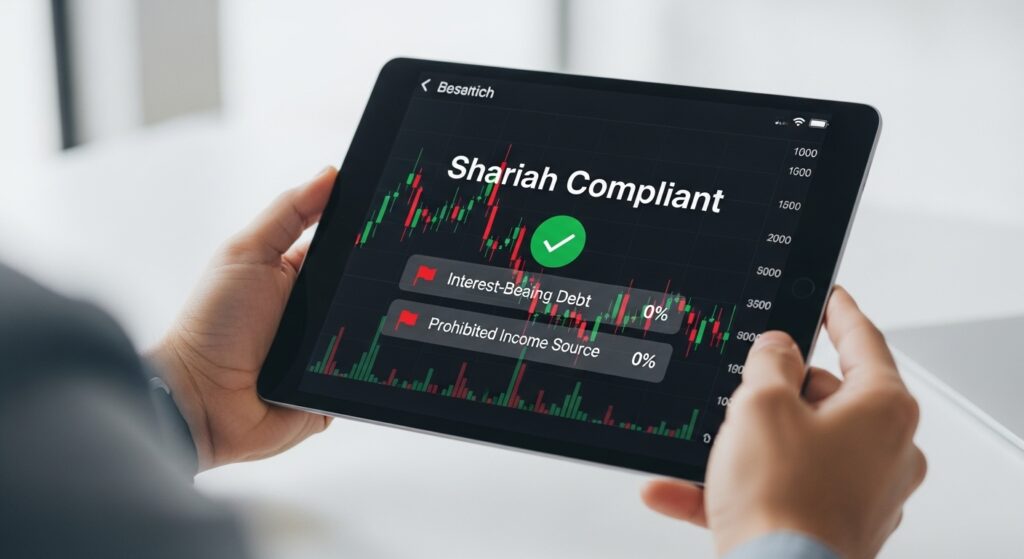
Stock Market Investments: Investing in the stock market is not inherently Haram. However, a Muslim investor must perform Shariah screening. International standards for this have been developed by bodies like the Accounting and Auditing Organization for Islamic Financial Institutions (AAOIFI). The screening involves two main filters:
- Business Activity Screening: The company must not derive more than 5% of its revenue from Haram activities like alcohol, pork, gambling, or Riba based finance.
- Financial Ratio Screening: The company’s finances must be sound. According to AAOIFI standards, its total interest bearing debt must be less than 30% of its market capitalization, and its interest bearing securities must also be below this threshold.
Manually checking every company can be incredibly difficult. This is where modern technology is a great help. The My Islamic Tools Halal Business Checker AI is a powerful resource designed for this. This tool uses AI to analyze businesses against established Islamic finance principles.
It can quickly screen a company’s operations and financial statements for compliance, making it much easier to navigate the complexities of Halal investing and avoid a Haram business in Islam. For more detailed information, you can read our deep dive into Halal stock screening.
Your Niyyah (Intention) and Striving for Halal
The journey to ensuring a Halal livelihood is a profound act of faith. The core principles are clear: avoid Riba, Gharar, Maysir, and prohibited goods. The line between a thriving, ethical enterprise and a Haram business in Islam is defined by these divine boundaries.
Your intention (niyyah) is the soul of your actions. When you sincerely strive to earn a Halal income for the sake of Allah, to provide for your family, and to contribute positively to the world, every moment of your work becomes an act of worship.
The path may require more effort, but the peace of mind and the barakah that comes from knowing your sustenance is pure is a reward that no amount of worldly wealth can match. Let this knowledge empower you to build a business that is not only successful in this life but also a source of reward in the hereafter.
Halal vs. Haram Business in Islam
A Muslim Entrepreneur’s Quick Guide to Ethical & Blessed Earnings
Halal Business
Permissible & Blessed. The foundation is that everything is Halal unless explicitly forbidden.
Core Principles
Fairness & Justice
No exploitation. Contracts are just and mutually beneficial.
Transparency
No hidden terms or deception (Gharar).
Real Economic Value
Provides a genuine, permissible good or service.
Modern Examples of Halal Income Sources
Haram Business
Prohibited & Harmful. Defined by clear “Red Lines” from the Quran & Sunnah.
The “Red Lines” – Key Prohibitions
Riba (Interest)
Making money from money without real trade. A core element of a **Haram business in Islam**.
Gharar (Uncertainty)
Excessive ambiguity or deception in contracts.
Maysir (Gambling)
Gaining wealth through pure chance and speculation.
Prohibited Goods
Dealing in alcohol, pork, idols, pornography etc.
Examples of Prohibited Businesses in Islam
Frequently Asked Questions
What really makes a business haram, and how is it different from a Halal business in Islam?
The core difference lies in adherence to Islamic business ethics. A **Haram business in Islam** is any venture that involves elements explicitly forbidden in the Quran and Sunnah. The four main “red lines” are Riba (interest), Gharar (excessive uncertainty/deception), Maysir (gambling/speculation), and dealing in prohibited goods or services (like alcohol or pork). In contrast, a **Halal business in Islam** operates ethically and transparently, providing permissible goods and services, ensuring all its activities contribute positively or, at a minimum, are not harmful, thereby securing **Halal income sources** for its owner.
I’m looking for Halal income sources. Can you list the main categories of prohibited businesses in Islam?
Certainly. To ensure you avoid a **Haram business in Islam**, here are the main categories of **prohibited businesses in Islam**:
- Interest-Based Finance: Any business based on **Riba in business**, such as conventional banking, mortgage lending, or interest-based loans.
- Gambling and Speculation: Casinos, betting websites, lotteries, and purely speculative trading.
- Prohibited Products: Businesses involved in the production, transport, or sale of alcohol, pork, idols, or pornography.
- Deceptive Practices: Ventures built on significant ambiguity or deception, like pyramid schemes or certain types of insurance and derivatives.
Why is Riba in business considered such a severe form of a Haram business in Islam?
**Riba in business** is considered one of the gravest sins in Islam, making any enterprise based on it a major **Haram business in Islam**. The Quran condemns it in the strongest terms, equating it to being at “war with Allah and His Messenger” (Quran 2:279). According to **Islamic business ethics**, Riba is prohibited because it allows the wealthy to increase their capital without effort or risk, purely at the expense of the borrower. It creates economic injustice, concentrates wealth, discourages real economic activity, and fosters a debt-based society, which is fundamentally against the principles of fairness and compassion in Islam.
What makes a business haram if it’s not obviously dealing in something like alcohol or pork?
This is an excellent question that goes to the heart of **Islamic business ethics**. A business can become a **Haram business in Islam** even if the product itself is Halal. The key is in the *process* and *contract*. For example, selling a permissible item like a car becomes haram if the transaction is financed through an interest-based loan (**Riba in business**). Similarly, an online store (dropshipping) can become haram if the seller creates excessive uncertainty (Gharar) by selling an item they do not own or control, with ambiguous quality and delivery terms. Therefore, understanding **what makes a business haram** requires looking beyond the product to the entire business model and its contractual basis.
Is my e-commerce dropshipping store considered a Halal business in Islam?
The permissibility of dropshipping depends entirely on its structure. If you sell products you don’t own or possess, creating uncertainty (Gharar) for the buyer about quality and delivery, it falls into a doubtful or **Haram business in Islam**. However, it can be a **Halal business in Islam** if structured correctly. Permissible models include acting as a clear agent (wakeel) for the supplier and earning a commission, or using a Salam contract where the customer pays in advance for a product with clearly defined specifications to be delivered at a future date. This transparency removes the prohibited uncertainty.
Can I invest in the stock market, or is that one of the prohibited businesses in Islam?
Investing in the stock market is not inherently a **Haram business in Islam**; it can be a valid source of **Halal income sources**. However, you must screen your investments. It becomes haram if you invest in companies involved in **prohibited businesses in Islam** (e.g., alcohol, conventional finance, gambling). Furthermore, the company must have low levels of interest-bearing debt and impermissible income (typically under 5%). This process, known as Shariah screening, ensures your investment aligns with **Islamic business ethics** and you are not profiting from **Riba in business** indirectly.
Do Islamic business ethics limit how much profit I can make?
No, Islam does not set a specific percentage cap on profits. A **Halal business in Islam** can be highly profitable. The key principle in **Islamic business ethics** is not the profit margin itself but the absence of injustice, deception (Gharar), and exploitation. As long as the price is mutually agreed upon in a transparent transaction, and you are not taking advantage of someone’s distress or a monopoly situation to price gouge, high profits are permissible. The focus is on ethical conduct, not on limiting the success that comes from providing value.