
The Journey to a Perfect Prayer
Identifying and correcting the common mistakes in Salah is one of the most vital steps a Muslim can take to deepen their connection with Allah (SWT). Salah is the second and most foundational pillar of Islam after the Shahada.
It is our direct, five-times-a-day appointment with our Creator, and the first thing we will be asked about on the Day of Judgment. When our Salah is in order, other aspects of our lives tend to fall into place. It is our spiritual anchor, our moment of peace, and our ultimate expression of submission and gratitude.
Allah (SWT) reminds us of its importance in the Quran: “Guard strictly the (five obligatory) As-Salawat (the prayers) especially the middle Salat (i.e. the best prayer ‘Asr). And stand before Allah with obedience.” (Quran 2:238).
Given its profound importance, shouldn’t we strive to make this appointment as perfect as possible?
We are all human. We get distracted, we forget, and we make mistakes. The journey of faith is not about achieving flawless perfection overnight, but about a continuous, sincere effort to improve. Recognizing our shortcomings is the first and most crucial step toward rectifying them. Striving to perform Salah correctly is not about pedantic obsession with rules; it is an act of love and reverence for the One we are standing before.
The purpose of this guide is to gently highlight some of the most common mistakes in salah that many of us, new and lifelong Muslims alike, may be making, often without even realizing it. We will explore these errors from before the first Takbeer to the final Tasleem, providing simple, authentic, and actionable ways to correct them, insha’Allah. Let this be a journey of refinement, aiming to turn our prayers from a mechanical ritual into a truly transformative conversation with Allah.
Part 1: Mistakes Made Before the Prayer Even Begins
The quality of our prayer is often determined long before we say “Allahu Akbar.” The preparation—both physical and mental—sets the stage for the connection we hope to achieve. Overlooking these initial steps is one of the most foundational and common mistakes in salah.
Rushing or Improper Wudu (Ablution)
The Prophet Muhammad (peace and blessings be upon him) said, “The key to Paradise is prayer, and the key to prayer is purification.” (Hadith – Tirmidhi). Wudu is not just about washing away physical dirt; it’s a profound act of spiritual purification, washing away minor sins with every drop of water. The Prophet (PBUH) also gave us glad tidings about its effects in the hereafter, saying, “On the Day of Resurrection, my followers will be called ‘Al-Ghurr Al-Muhajjalun’ from the traces of Wudu, and whoever can increase the area of his radiance should do so.” (Sahih al-Bukhari).
The Mistake: In our rush to catch the prayer, especially in congregation, Wudu can become a frantic splash of water. We might wash our limbs incompletely, leaving dry patches on our heels, elbows, or between our fingers and toes. We might perform the steps out of order or wash each limb only once when the Sunnah is to do so three times. This haste can render the entire purification invalid, and consequently, the prayer that follows it.
How to Fix It: Treat Wudu as an integral part of the prayer itself, not a chore to be rushed through. Perform it with mindfulness and care, ensuring that water reaches every single part of the required limbs.
- Be Deliberate: Slow down. Consciously perform each step, from washing the hands to the feet.
- Ensure Complete Coverage: Pay special attention to areas often missed, such as the back of the ankle, the elbows, and behind the ears. Rub the water in, don’t just let it run over the skin.
- Follow the Sunnah: While washing once is the minimum, striving to wash each limb three times is the practice of our beloved Prophet (PBUH) and carries greater reward.
- Conserve Water: Being meticulous does not mean being wasteful. Following the Sunnah also means using water judiciously, as the Prophet (PBUH) did.
Think of each drop of water extinguishing a minor sin. When viewed through this lens, the motivation to perform Wudu with excellence increases dramatically.
Incorrect Niyyah (Intention)
Niyyah is the spiritual bedrock of every act of worship. The famous hadith states, “Actions are but by intentions, and every man shall have only that which he intended.” (Hadith – Bukhari & Muslim).
The Mistake: A common misconception is that Niyyah is a specific formula that must be verbalized, like “I intend to pray four rak’at of Dhuhr for Allah…” While there’s no harm in this, the mistake lies in reciting it out of habit, like a robot, without any real presence of the heart and mind. The true mistake is starting the prayer with a vacant heart, not consciously dedicating that specific act of worship to Allah. The great scholar Imam Ibn Taymiyyah clarified this, stating, “The place of the Niyyah is the heart by the consensus of Muslim scholars.”
How to Fix It: The fix is simple yet profound: take a moment of pause before you say the opening Takbeer.
- Center Your Heart: Stand on your prayer mat, face the Qibla, and take a deep breath.
- Consciously Form the Intention: In your mind and heart, acknowledge which prayer you are about to perform (e.g., Fajr, Dhuhr, Asr) and that you are doing it solely for the sake of Allah. That’s it. That silent, conscious resolve is your Niyyah.
- Avoid Distractions: This pre-prayer pause helps you mentally disconnect from the dunya (worldly life) and prepare to enter into a sacred conversation.
Making a clear, heartfelt intention is the first step in battling distraction and is essential to avoid one of the key common mistakes in salah. It transforms the act from a mere physical exercise into a meaningful act of worship.

Part 2: Common Mistakes in Salah During Standing (Qiyam) & Recitation
Once the preparation is complete, we enter the prayer itself. The standing portion (Qiyam) is where we recite the words of Allah. Errors here can relate to both our physical actions and the quality of our recitation.
Incorrect Takbeer al-Ihram (Opening Takbeer)
The Takbeer al-Ihram (“Allahu Akbar”) is what initiates the state of prayer. The word “Ihram” comes from the same root as “haram” (forbidden), because upon saying it, the permissible acts of talking, eating, and looking around become forbidden until the prayer is concluded.
The Mistake: Two mistakes are common here, especially in congregational prayer. The first is raising the hands incorrectly—either not high enough, too high, or in a flicking motion. The second, and more critical mistake, is saying “Allahu Akbar” before the Imam says it. The Prophet (PBUH) warned, “The Imam is appointed to be followed, so do not differ from him. When he says ‘Allahu Akbar,’ then you say ‘Allahu Akbar.'” (Sahih al-Bukhari). Rushing ahead of the Imam means you have not actually joined his congregation.
How to Fix It:
- Proper Hand Position: The Sunnah is to raise the hands, with fingers together and facing the Qibla, to the level of the shoulders or the earlobes. It should be a calm, deliberate motion.
- Timing is Everything: In congregation, listen carefully. Wait until the Imam has completely finished saying “Allahu Akbar” before you begin saying yours. Your Takbeer must come after his. This simple act of waiting ensures you are correctly following the leader of the prayer.
Rushing Through Recitation (Especially Surah Al-Fatihah)
The Prophet (PBUH) once described the worst type of thief as “the one who steals from his own prayer.” The companions asked, “O Messenger of Allah, how does one steal from his prayer?” He replied, “He does not complete its bowing and prostrations.” Rushing is a form of theft; it robs the prayer of its essence and reward.
The Mistake: This is perhaps one of the most widespread common mistakes in salah. We recite Surah Al-Fatihah and the subsequent surah at lightning speed, slurring words together, and not pausing between verses (ayahs). This haste prevents us from contemplating the meaning and breaks the intimate connection that recitation is meant to foster.
How to Fix It: Embrace the concept of Tarteel, as commanded by Allah: “…and recite the Qur’an with measured recitation.” (Quran 73:4).
- Pause After Each Verse: The Prophet (PBUH) used to pause at the end of each ayah of Al-Fatihah. This is a beautiful Sunnah that instantly slows you down and allows you to breathe.
- Internalize the Divine Response: Remember the sacred Hadith (Hadith Qudsi) where Allah (SWT) says He has divided the prayer between Himself and His servant. When the servant says, “Al-hamdu lillahi Rabb il-‘alamin,” Allah says, “My servant has praised Me.” When the servant says, “Ar-Rahman ir-Rahim,” Allah says, “My servant has glorified Me.” When we pause, we create space to feel this divine response in our hearts. This transforms recitation from a monologue into a dialogue.
- Focus on Pronunciation (Tajweed): While not everyone is an expert in Tajweed, a sincere effort to pronounce the Arabic letters correctly is essential. Rushing makes correct pronunciation impossible. You can find many resources online to improve your recitation. For further reading on this topic, consider resources from reputable sites like Yaqeen Institute for Islamic Research.
Looking Around or Losing Focus
Khushu (humble concentration and devotion) is the soul of the prayer. Without it, the prayer becomes an empty shell. One of the biggest physical contributors to a loss of Khushu is a wandering gaze.
The Mistake: Letting the eyes dart around the room, looking at the person next to you, checking the clock, or inspecting the patterns on the carpet. Every glance is an invitation for Shaytan to pull your mind completely out of the prayer. The Prophet (PBUH) was asked about this and said, “It is a snatching that Shaytan steals from the prayer of the servant.” (Sahih al-Bukhari).
How to Fix It: The solution is a simple physical discipline taught to us by the Prophet (PBUH).
- Fix Your Gaze: The Sunnah is to keep your eyes focused on the spot where your forehead will touch the ground during Sujood (prostration). This simple act physically locks your focus and helps to mentally contain your thoughts.
- Minimize Distractions: Before you start, try to pray in a spot with minimal distractions. Avoid facing walls with busy pictures, shelves full of books, or windows with a view of outside activity. A clear space helps create a clear mind.
- Seek Refuge in Allah: If you find your mind wandering, you can discreetly seek refuge in Allah from Shaytan by saying “A’udhu billahi minash-shaytanir-rajim” in your mind before you continue your recitation.
Part 3: Mistakes in Ruku’ (Bowing) and Sujood (Prostration)
The physical movements of prayer are acts of worship in themselves. They symbolize our humility and submission. Performing them correctly and with tranquility is paramount.
Not Achieving Tuma’ninah (Stillness)
This is a major error that, according to many scholars, can invalidate a prayer. Tuma’ninah means to be still and tranquil in each position for a moment before moving to the next. The gravity of this is highlighted in the famous hadith of the “man who prayed badly,” whom the Prophet (PBUH) told three times, “Go back and pray, for you have not prayed.” Only then did he teach him to be calm and still in every posture.
The Mistake: This is famously described as “pecking like a chicken” or “pecking like a crow.” It’s the act of rushing from Qiyam into Ruku’, barely bowing before shooting back up, and then immediately dropping into Sujood without any pause. The bones don’t have a chance to settle in each position. This haste completely nullifies the posture’s spiritual benefit and is a severe form of “stealing from the prayer.”
How to Fix It:
- The Three-Second Rule: A practical tip is to ensure you stay in each position long enough for your bones to settle.
- Calm Tasbeeh: In Ruku’, pause and say “Subhana Rabbiyal Adheem” (Glory be to my Lord, the Most Great) at least three times, calmly and clearly. Don’t rush the words. The same applies in Sujood with “Subhana Rabbiyal A’la” (Glory be to my Lord, the Most High).
- Feel the Posture: When you are in Ruku’, feel the position of bowing to your Lord. When you are in Sujood, feel the position of ultimate closeness and submission. Tuma’ninah allows the heart to catch up with the body.
Incorrect Posture in Ruku’
Ruku’ is a position of immense glorification of Allah. The posture should reflect this. Describing the Prophet’s prayer, `Aisha (RA) said, “When he [the Prophet PBUH] bowed, he would neither raise his head nor lower it, but would keep it in between.” (Sahih Muslim).
The Mistake: Common postural errors include arching the back like a camel’s hump, letting the head droop too low, or not bowing down far enough, resulting in a curved or uneven back.
How to Fix It:
- The Tabletop Back: The ideal Sunnah posture is a straight, flat back, parallel to the ground. It should be so flat that if a cup of water were placed on it, it would not spill. Your head should be in line with your back, not tucked in or raised up.
- Hand Placement: Your hands should be firmly gripping your knees, with the fingers spread. This helps to stabilize the posture and straighten the arms and back.
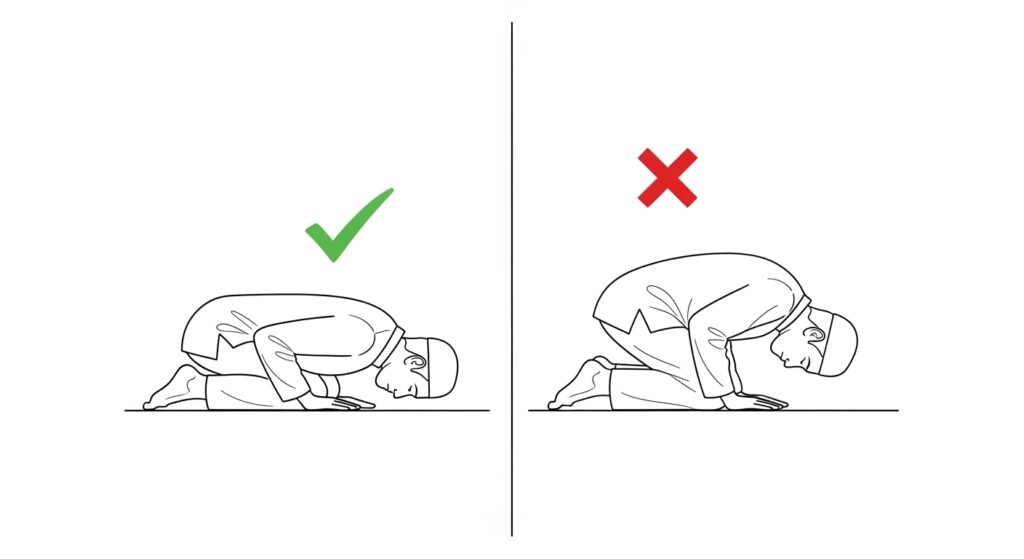
Incorrect Posture in Sujood
Sujood is the pinnacle of the prayer, the moment we are closest to Allah. Perfecting this position is an act of love.
The Mistake: These are critical common mistakes in salah to avoid. For men, a very frequent error is laying the forearms and elbows flat on the ground. The Prophet (PBUH) explicitly forbade this, saying, “Be straight in prostration, and let none of you put his forearms on the ground like a dog.” (Sahih al-Bukhari). Another is lifting the feet off the ground during prostration or not having the nose touch the ground along with the forehead.
How to Fix It:
- The Seven Points of Contact: The Prophet (PBUH) said, “I have been commanded to prostrate on seven bones: on the forehead — and he pointed to his nose — the hands, the knees and the edges of the feet.” (Sahih al-Bukhari, Sahih Muslim). Ensure all are firmly on the ground.
- Elbows Up (for Men): Men should keep their elbows raised and away from their sides and off the floor. This distinguishes the posture and is the direct command of the Prophet (PBUH). Women, for reasons of modesty, may keep their arms closer to their body.
- Feet on the Ground: Be conscious of your feet. It’s easy to let them lift off the ground, especially when getting up from Sujood. Make a mental note to keep your toes firmly planted and pointing towards the Qibla throughout the prostration.
Part 4: Mistakes in Sitting (Jalsa) and Concluding the Prayer
The final stages of the prayer require just as much focus and tranquility as the beginning. Rushing to finish is a common pitfall.
Rushing the Sitting Between Two Sujoods (Jalsa)
The Jalsa is the short sitting period between the two prostrations. It is a full position of its own, not merely a brief transition. The companion Anas ibn Malik (RA) noted that the Prophet (PBUH) “would sit between the two prostrations for so long that we would think he had forgotten.” This shows the importance he gave to this posture.
The Mistake: Many people drop into the first Sujood, then barely lift their head before immediately going down for the second one. There is no pause, no straightness of the back, and no Tuma’ninah. This is another form of “pecking.”
How to Fix It:
- Sit Up Straight: After the first prostration, come to a complete sitting position, so your back is straight and you are settled.
- Pause and Make Du’a: This position has its own beautiful supplication. The Prophet (PBUH) used to say, “Rabbigh-fir li, Rabbigh-fir li” (O Lord, forgive me, O Lord, forgive me). Reciting this not only ensures you pause long enough but also fills this moment with a plea for mercy. You can learn the full Dua Between the Two Sujoods here.
Fidgeting or Rushing During Tashahhud
The Tashahhud is a powerful part of the prayer, containing greetings to Allah, the Prophet, and the righteous servants of God.
The Mistake: Reciting the At-Tahiyyat, Salawat, and final duas at high speed without comprehension. Another common error is excessive fidgeting—playing with one’s beard or hijab, scratching, or moving fingers unnecessarily (other than the prescribed Sunnah of pointing the index finger). A scholar of the past, Bakr ibn Abdullah al-Muzani, said, “If you want your prayer to be of benefit to you, then say to yourself before you start, ‘Perhaps I will not have the chance to perform another prayer.'” This mindset helps to eliminate rushing and fidgeting.
How to Fix It:
- Understand the Words: Take the time to learn the meaning of the Tashahhud. When you understand that you are reciting the words of a divine conversation, you will naturally recite it with more reverence. You can find a complete guide to the Tashahhud on our website.
- Maintain Stillness: Be conscious of your body and resist the urge to fidget. Keep your hands placed on your knees/thighs as prescribed and maintain your focus until the very end of the prayer.
Incorrect Tasleem (Saying Salam)
The Tasleem concludes the prayer, exiting the sacred state of Ihram.
The Mistake: A quick, slight nod of the head to the right and left, without a full turn. Or, in congregation, turning one’s head and saying “Assalamu Alaikum wa Rahmatullah” before the Imam has completed his second Tasleem.
How to Fix It:
- Turn Your Head Fully: Follow the practice of the Prophet (PBUH). A companion, `Abdullah ibn Mas’ud (RA), narrated that the Prophet “used to say salam to his right and to his left, until the whiteness of his cheek could be seen.” (Sunan an-Nasa’i).
- Wait for the Imam: Just as with the opening Takbeer, wait for the Imam to complete his final Tasleem before you begin yours. The prayer in congregation is one of unified, disciplined followership.
FAQs About Common Mistakes in Salah
Q1: What should I do if I realize I made a mistake during prayer? This depends on the mistake. For forgetting an obligatory part (Wajib) of the prayer or being in doubt, Islam prescribes a simple rectification: the Sujood as-Sahw (Prostration of Forgetfulness). It involves performing two extra prostrations before the Tasleem. For more detailed guidance, see our article on when and how to perform Sujood As-Sahw.
Q2: Does making these mistakes invalidate my prayer? It depends on the nature of the mistake. Scholars categorize parts of the prayer into pillars (Arkan), obligatory acts (Wajibat), and recommended acts (Sunan). Missing a pillar (like Ruku’ or Sujood) intentionally or unintentionally requires you to repeat the prayer. Missing an obligatory act (like Tuma’ninah or the first Tashahhud) can be rectified by Sujood as-Sahw. Missing a Sunnah act does not invalidate the prayer but reduces its reward. The goal is to always strive for correctness and seek Allah’s forgiveness for our shortcomings.
Q3: How can I improve my concentration (Khushu) to avoid these errors? Improving Khushu is a lifelong struggle. Here are three practical tips:
- Seek Refuge: Before starting, consciously seek refuge in Allah from the whispers of Shaytan.
- Understand What You Recite: The more you understand the meaning of the Quran and the supplications, the more your heart will be engaged.
- Prepare Your Space and Mind: Pray in a clean, quiet place. Arrive a few minutes early for prayer to calm your mind and disconnect from worldly thoughts.
The Journey to a Perfect Prayer
We have journeyed through the prayer, from the purity of Wudu to the peace of the final Tasleem, highlighting the common pitfalls along the way. The most frequent errors almost always stem from three root causes: rushing, incorrect posture, and a lack of focus.
By cultivating Tuma’ninah (stillness), learning the correct physical form for each position, and making a conscious effort to be present in our conversation with Allah, we can transform our Salah from a habit into a heartfelt act of worship.
Remember, this is not about achieving an impossible standard of perfection overnight. Salah is a continuous journey of improvement, not a destination. Allah does not expect perfection, but He loves to see our sincere effort. Every prayer is a new opportunity to get a little bit closer, a little bit better.
We ask Allah Al-Mussawwir (The Fashioner) to shape our prayers into a form that is pleasing to Him, to grant us Khushu in our hearts, and to accept every bow and prostration we make for His sake alone. Ameen.